 Smart Portable Toilet Supplier
Standard Portable Toilet in Anaheim, CA
The standard unit is the right call when your need is straightforward: a crew that needs a restroom on site all week, a backyard project in West Anaheim, a church parking-lot event, or a job trailer setup in the…
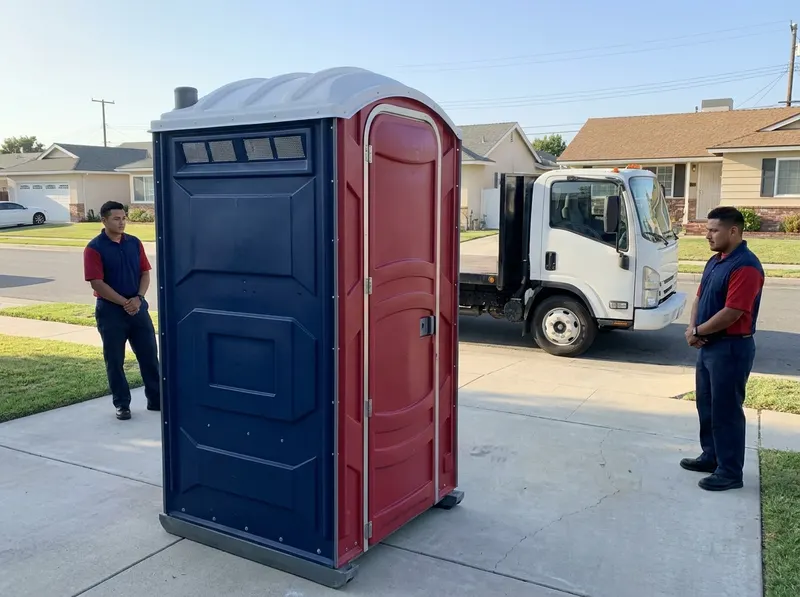
- Included with every standard portable toilet: delivery, setup on level ground, toilet paper, hand sanitizer dispenser, and scheduled pump-out with tank recharge.
- Delivery in Anaheim is scheduled with a confirmed time — not a vague all-day window — and same-day or next-day placement is often possible when a unit is available.
- Standard portable toilet rental in Anaheim generally runs about $250 to $400 for a one-week or short-term rental, with monthly construction rates commonly in the $250 to $450 range including weekly service; $250 is the minimum charge.
- A standard unit handles ordinary restroom use for work crews and events; it does not include a sink, flushing, or lighting, and it is not the ADA-compliant option.
- To book, call (854) 292-4321 with your address, dates, and where the unit should sit — a free pre-job site visit is available anywhere in Anaheim if access is tight.
The standard unit is the right call when your need is straightforward: a crew that needs a restroom on site all week, a backyard project in West Anaheim, a church parking-lot event, or a job trailer setup in the Platinum Triangle where space is measured in inches. A standard toilet occupies roughly a 4-by-4-foot footprint and stands about 7 to 7.5 feet tall, so it slips into a driveway edge, a side yard in The Colony, or a striped parking stall near Angel Stadium without eating a full lane. Where it is not the right unit: if a health inspector, permit, or ADA requirement is in play, you need the wheelchair-accessible model instead, and if guests will be in nice clothes at a wedding near Pearson Park or Anaheim GardenWalk, a flushing or restroom-trailer option reads better. The trade-off is honest — standard units cost the least and go almost anywhere, but they are non-flush, unlit, and sink-free unless you add a hand-wash station alongside.
Anaheim geography changes placement more than most people expect. In Anaheim Hills, Peralta Hills, and Sycamore Canyon, driveways pitch hard and lots are cut into slope, so we look for a flat pad or use leveling material — a unit set on a grade is the number one cause of a tank that reads full early and a door that will not stay shut. In the Anaheim Colony Historic District and older parts of East Anaheim, alley access and narrow curb cuts mean we often place from the alley rather than the street. Near The Resort District and the Convention Center, we plan around traffic timing and hotel loading zones, and we keep units out of guest sightlines when the host asks. If your spot worries you, the free site visit exists exactly for that — we walk it, confirm the drop point, and you find out before the job starts, not the morning your crew shows up.
Service is what keeps a standard unit usable, and it gets a written schedule rather than a promise. Weekly pump-out is the norm for a construction unit with a typical crew; higher headcount, hot Santa Ana wind stretches, or a longer shift schedule may call for twice-weekly. Each service visit pumps the tank, recharges deodorizer, restocks paper, and wipes down interior surfaces — and we can send a photo of the serviced unit on your Anaheim site if you need it for your own records or a client update. Bel Aire homeowners doing a driveway or ADU project usually get a single unit and forget about it; supers running phased work near Yorba Regional Park or the Honda Center area typically rotate placement as the work moves, which we handle on the same call.
On cost, we quote plainly. Every price we give is a ballpark until we see the site, and the exact number gets confirmed at the free visit or over the phone once we know access, duration, and service frequency. What drives the figure: rental length, how many service visits per week, whether a lift or long-carry placement is needed, and how far the drop is from a serviceable route. Delivery and standard weekly service are stated in the quote — not added after. Call (854) 292-4321 with your date and we will tell you what is available and when it will land.
What it costs
Every job gets a firm, written price after a free on-site visit.
Common questions
How many workers does one standard portable toilet cover on an Anaheim job site?
Will a standard unit fit a steep driveway in Anaheim Hills or a narrow alley in the Colony?
What is the minimum cost for a standard portable toilet in Anaheim?
Does a standard portable toilet in Anaheim include a hand-washing sink?
How fast can you deliver a standard portable toilet in Anaheim?
Ready to get started?
Tell us about your standard portable toilet job in Anaheim and we'll send a clear, written quote — usually the same day.